

J. Michael Collins guarantees that all work is authentic and will never be created by a voice clone or AI model.

JMC Voiceover Source Connect
jmichael@jmcvoiceover.com
202-329-9044
  • Home
  • My Demos
    • Commercial
    • TV Promo
    • TV Narration
    • Medical
    • eLearning
    • Corporate
    • Automotive
    • Radio Imaging
    • Telephony
    • Political
  • Recent Work
  • Demo Production
    • Demo Production
    • Demo Production Guide
    • Commercial
    • TV Promo
    • TV Narration
    • Animation
    • Video Game
    • eLearning
    • Corporate
    • Explainer
    • Medical
    • Political
    • Radio Imaging
    • TV Affiliate
    • Automotive
    • Telephony
  • Coaching
    • Coaching
    • Voiceover Coaching Guide
  • Photo Gallery
  • Success Club
  • Podcast
  • Events
    • Euro Voiceover Retreat
    • VO Atlanta
    • One Voice Conference USA
  • Public Speaker Training
    • Public Speaker Training
    • Public Speaking Coach
  • Giving Back
  • Blog
  • Contact

Blog

Takeaways From VO Atlanta: Family, Evolution, and Changes Coming to Online Casting

by J. Michael Collins 4 Comments

vo-atlanta-participants-having-fun

I’m a bit late to the game this year as far as VO Atlanta wrap-ups go. Between a touch of jet lag, (I made a rare-for-me decision to take an overnight flight back so as not to miss too much work,) a multi-day marathon of jobs and administrative stuff to sort through upon our return, and some post-conference crud floating around the house this weekend, I’ve been a little preoccupied.

That said, three things stuck out for me at VO Atlanta this year, and all three are, in my opinion, highly important for our community and industry. I’ll get to them in a moment.

Let me begin by paying the usual homage to the event itself, it’s familial undercurrent, and the brilliance of Gerald Griffith and his team. No battle plan survives first contact with the enemy, and I never fail to find it remarkable how the VO Atlanta organization pivots successfully when confronted with the unexpected.

Kay Bess was an inspiration to everyone, and there wasn’t a dry eye after her keynote.

JMC-and-friends-at-vo-Atlanta

Seeing old friends and making new ones was as joyful as expected. The traffic at the JMC Demos booth left my whole team with little downtime, (and a huge thank you to AJ, Kayla, Jas, the Sundholms, Megann, Brigid, Brad and Jace for their help.) And the closing ceremonies were moving and uplifting as always. I expressed my gratitude to Gerald for filling a few minutes between bringing young Briley on stage and the Unicorn Award presentation…..I’m not sure I could I have held it together otherwise after seeing that courageous little girl.

The tribute to Pat Sweeney put together by Elley-Ray and Jenn Henry was breathtaking, and it was a privilege to present a token of the community’s appreciation to his family.

And, Michelle Blenker is our new Unicorn, selected from an impossibly worthy field of three finalists including Bev Standing and Doug Turkel….all examples of the better angels of humanity.

accepting-awards-on-stage-at-vo-Atlanta

So, on to the takeaways.

1.) Families Come Together

This year there was an unusual amount of behind-the-scenes politics and contentiousness heading into the weekend. Various quarters of the industry had been quietly quarreling for some months, for reasons well known and others more esoteric. A number of us had some concern that petty disagreements and personality conflicts would come to a head this year in Atlanta in ways they had not before.

It was refreshing, (which is appropriate,) to see that this was not the case. As always seems to happen in Atlanta, the communal celebration of our industry eased whatever conflicts may have been percolating, and reminded us all that while we may disagree on methods and philosophy, the kind of people who take the time to make the annual pilgrimage to the South all have the best interest of the industry at heart.

2.) Non-Broadcast Narration Is Now Sexy

For years, broadcast sectors have held the glamor position in voiceover. As competition has increased and pay has come under pressure due to market forces in Commercial VO, among others, many of us have been championing the advent of less-traditional parts of the industry as the path to a prosperous future.

This year’s conference made clear that E-Learning, Corporate Narration, Explainers, and formerly niche areas like Political Commercials and Live Announce are becoming bell cows for a lot of talent. Instead of being treated as beneath or less-than high profile broadcast work, these genres were recognized in Atlanta as abundant, lucrative, and less competitive than other parts of the industry. E-Learning masters were highlighted as stars in a VO version of Revenge of the Nerds that most wouldn’t have seen coming five years ago.
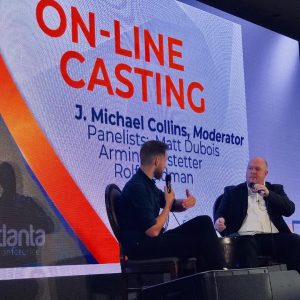
panel-discussion-at-vo-Atlanta

3.) Online Casting Is Changing Rapidly

A lot has been written about my interview series with the CEOs of Vocie123, bodalgo.com, and Voiceovers.com. I’ll let the interviews and commentary by others stand without adding anything else here, other than one observation that I believe is critical.

My big takeaway is that we may be seeing a gradual shift among online casting sites to two fairly distinct models, both based solely on the long-term interests and intentions of the site owners.

Going forward, I would expect to see online casting sites start to take two very clear forms, (keeping in mind that some sites, like Voice123 and Voiceovers.com, don’t currently fit either mold.)

Where the intention of ownership is to scale up operations with the possible purpose of cashing out in the long term via private sale or IPO, you can expect to see sites adopt models that look more and more like other gig economy platforms.

This will take the form of paywalls at almost every interaction for the labor force on the site: Membership fees, commissions, possibly the introduction of paying small amounts for individual auditions, (see what Upwork is doing to their freelancers at the moment,) and the monetization of any possible convenience on the site. The more aggressive sites will try to implement the same on the buyer side.

These sites will also center more and more around sorting metrics and AI, rating and categorizing talent in ways that make sense to Silicon Valley types but which seem cold and impersonal to creatives. The feel will be far more corporate than artistic.

Ultimately, the philosophy is driven by chasing volume, not quality, and sites that follow this model will start to resemble Fiverr and freelance sites more and more, allowing virtually anything onto the platform and making their money in small increments on massive traffic. Private equity and corporate investors don’t really care about quality…..there is no money in a boutique high-end professional VO site. At least not what the investment community would consider real money. It is all about traffic and turnover. The more the merrier. Uber doesn’t care if you are going five hundred yards or fifty miles. They make money on both.

Sites that follow this model will become less and less responsive to the community and to talent concerns, seeing themselves as tech platforms first, not stewards of the industry they serve. Customer service will cease to exist on these sites, and every encounter will be transactional.

On the other side will be the industry-centric matchmakers. Sites which derive their income strictly from membership fees, playing no other part in the transaction and making the process as simple as possible for all players.

These sites will continue to support and interact with professional talent, and will screen the jobs on their platforms for at least a minimum of quality. Their ownership and customer service philosophy will remain accessible because community acceptance and backing will dictate their success. Without recourse to pennies on the dollar volume transaction profits, they have to be responsive to talent and buyers alike in order to thrive. Ownership of these sites will find profit, but it will be in concert with that of their talent, and the owners will not be getting rich from these platforms.

The biggest challenge they will face is attracting jobs when they are forced to compete for SEO relevance and traffic with the big aggregators. How well they meet this challenge will determine if the model will survive.

Ultimately, online casting is in a state of flux, and other models may emerge, but for the moment this is where things seem to be moving. As always, diversifying your job sources will be critical to your future VO success. Platforms change. They will come and go. I remain convinced that a VO portfolio without online casting is a poor idea for most talent, but online casting should not be over-weighted in your mix. If it accounts for more than 20% of your income, it’s time to take a hard look at your approach.


Filed Under: Blog, Voiceover Industry

The One Thing You MUST Pack for VO Atlanta

by J. Michael Collins 1 Comment

VO-Atlantic-conference-logo

As we pack for VO Atlanta 2019 this coming week, the excitement is palpable. It will feature hundreds of hours of content spread over four days; the industry’s biggest conference never fails to be an event to remember. It is a celebration of learning, networking, socializing, and friendship unlike anything else in the industry. This year, over 700 attendees are expected to join over 50 of the voiceover industry’s leading talents, agents, casting directors, managers, branding and marketing experts, service providers, and other assorted VO luminaries for a week that will help many talents take their careers to the next level.

The voiceover space is famous within the entertainment industry for being unusually supportive and collegial. We look out for ourselves and think of ourselves as one big family. Like all families, there are disagreements and points of tension from time to time, but in the end, we all rise together, and nowhere is that reflected better than at VO Atlanta. Somehow, being among friends and colleagues who share the daily struggles of being a solopreneur in a rapidly changing business makes all the petty arguments seem unimportant and inevitably leads to a coming together as a community.

So as you pack your suitcases, plan your outfits, and try to cram an entire portable studio into a bag, make sure you remember the one thing that is most essential for an enjoyable weekend at VO Atlanta: A smile.

Anna and I are bringing ours, and we can’t wait to see you there!

Filed Under: Blog, Voiceover Industry

The Decline of Commercial Voiceover Isn’t The End of the World

by J. Michael Collins 7 Comments

commercial-break-voiceover-slide

I had an interesting epiphany the other day on the decline of commercial voiceover. After booking a big-brand commercial client through a website walk-in, I took stock of my daily rake: One fantastic commercial client and a smaller one. Three Corporate Narration jobs. One new E-Learning client and a repeat from a steady customer. One stray Telephony job. Guess what got me excited? Hint: It wasn’t the big commercial win. I’ll do a few spots for them at a fair rate, and then, like most commercial clients in today’s marketplace, they will probably move on. However, one of those three Corporates will likely become a weekly customer for the next few years. And the E-Learning client has the potential to add tens of thousands of words of narration to my invoice list each year for the foreseeable future.

A sexy new commercial client would have made my week even a few years ago. Having a chest-thumping brand to add to the client list and a sharp spot or five for your portfolio later on was always a signature score. The ego stroke is still nice, but the commercial voiceover business remains in deep flux and substantially declines.

Shifts in media consumption habits, a reflexive aversion to advertising among young people, and a technology-driven increase in the supply of quality voice actors, (most of whom are attracted to the glitz of hearing their voices on air,) have lead to a massive change in the market. Ads are now more targeted, meaning smaller audiences, generally lower budgets, and less ROI. The days of being the “voice of” for years, or even a year, are rapidly ending as commercial buyers constantly react to the latest metrics with new ad concepts. The supply of great commercial voice actors, once limited to LA and New York, is now plentiful and armed with professional  home studios that sound as good as the best storefront locations. Commercial buyers have choices, and in most cases find themselves with substantial power to dictate pay. 

If you’re waiting for my usual silver lining, you’re going to be disappointed. While I strongly suspect commercial rates have hit a floor, things aren’t going back to the good old days. As much as we fight the trend, the inevitable result of a supply/demand imbalance in favor of those on the demand side is that those on the supply side have to adapt and innovate. Commercial buyers will continue to move away from high-cost models wherever they can get away with it. Most will not compromise quality to save a buck, but they WILL look for a middle ground. The union, agents, talent managers, and casting directors are under more pressure than ever before because of this. Many of the traditional commercial VO gatekeepers, while touting their remaining high-profile clients and trying to put on a smile in public, are privately worrying about how long they will be able to keep the doors open. In recent months we have seen a slew of castings from very well-respected sources that five years ago would have been rejected out of hand for the rates offered. Multiple cut downs with little or no extra pay. Long cycles or even buyouts. Occasionally exclusivity without reasonable compensation. The writing is on the wall.

Like all market changes, this isn’t the end of the world, but rather perhaps simply the end of A world, or an era. The future of commercial is likely to be less pay but higher volume. New media means that while the audience and budgets are smaller, there is more actual content than ever before. Advertisers are becoming more clever with regard to creating content that doesn’t scare off younger consumers with hard sells. The content itself is becoming edgier, more authentic, and fun to voice.

Moreover, future-forward talent are embracing the industry’s growth sectors, like E-Learning, Corporate and Explainer Narration, Medical Narration, Political Commercial, Animation and Video Games. The non-broadcast genres listed here require highly-competent, focused, and disciplined voice actors, and the demand in these genres far outstrips the supply, which means pay is rising and talent hold the advantage in negotiations. The same applies for Political Commercial VO, while Animation continues to be a high-dollar holy grail of union work, though with more competition. Video Games, despite middling pay, are launching pads for talent brands which can lead to rapid career growth, and they are the cultural touchstones for millions of young consumers, meaning top actors may be able to garner bigger paydays for commercial work in the future if they establish themselves as influencers. 

The question is, how will you build your career? It’s easy to complain about market forces reducing what had long been one of the industry’s cash cow glamor genres to a volume-oriented hustle. However, the wiser course is to adapt and thrive in the new normal while maintaining reasonable standards, and pivoting to embrace the sectors of the industry that the next generation of top voiceover earners will arise from.

Filed Under: Blog, Voiceover Industry

Lessons from Across the Pond

by J. Michael Collins 3 Comments

flag-for-country-across-the-pond

In my last article, I spoke of this as a new Golden Age of Voiceover, in which opportunity is more abundant than ever. However, that doesn’t mean that we live in an era free of dangers. Quite the opposite. Legislation from across the pond can show how voiceover licensing is handled. Our industry has learned that corporate interests would like to exert control over our work, which infringes upon our rights to license what we produce and how much we are paid. What we’ve experienced so far is the first wave of predators. These have mostly taken the form of VO-industry-centric startups that have grown to become significant players in our small little world. Some have acted nobly, some have straddled a fine line between talent interests and corporate/buyer interests, and some have gone full evil.

Yet, this is only the first wave. Our industry is vulnerable for two reasons:

1.) There is enough money at play to begin attracting interest from players outside of our little world.

2.) Technology implemented to control voiceover casting can easily be adapted to the far more lucrative world of on-camera casting.

The second wave threat to the voiceover business will be from big money interests who wish to prove they can profit off of our backs before making sure the next George Clooney can only find work on their terms through their portals. Amazon, Facebook, Google….they are coming. Billion-dollar private equity firms are coming. Heck, some of them may already be here.

How in the world do we fight back against that kind of influence?

Some are working on waking the union from its slumber on technology and prodding them to be both more inclusive and aggressive. This is a highly noble goal that should be strongly supported.

But bigger guns may still be required.

Earlier this month, the European Parliament, the Council of the EU, and the European Commission (together, these are the bodies primarily responsible for crafting legislation that applies to all European Union countries) completed an agreement on new rules to “make the copyright rules fit for the digital era in Europe and bring tangible benefits to all creative sectors, the press, researchers, educators, cultural heritage institutions, and citizens.” Once formally confirmed by the European Council and Commission, which is a formality, the law will be published in the Official Journal of the EU. The member states will have 24 months to transpose the new rules into their national legislation.

According to the European Commission’s press release (https://bit.ly/2TYRuCg), the impact of the legislation will include the following:

  • Tangible benefits to all creative sectors, specifically creators and actors in the audio-visual and musical sectors, by reinforcing their position vis-à-vis platforms to have more control over the use of their content uploaded by users on these platforms and be remunerated for it.
  • The principle of appropriate and proportionate remuneration for authors and performers will be laid down for the first time in European copyright law.
  • Authors and performers will enjoy access to transparent information on how their works and performances are exploited by their counterparts (publishers and producers). This will make it easier for them to negotiate future contracts and receive a fairer share of the generated revenues.

Ultimately, this legislation (though primarily inspired by the difficulties faced by authors and musicians) will substantially influence how voiceover licensing is handled within European Union countries. It is likely to lead to a much more talent-friendly environment and keep that environment from being eroded by corporate greed.

Now, the United States and Canada are not Europe. Politicians, especially in the US, have historically been far more friendly to big business needs than the little guy. But the times, they are a-changin’.

As the worker’s voice becomes louder across the United States, driving political earthquakes on both sides of the aisle, politicians are likely to become far more receptive to backing legislation designed to protect artists and performers from rapacious corporate interests. On both the left and the right, cloaking oneself in the approval of everyday working Americans is the wardrobe of choice at the moment, and it is perhaps a moment that our industry should not fail to seize.

It’s one thing for us to collectively be vigilant, to organize into non-union industry guilds, and reconstitute a stronger talent union if those initiatives pan out…..but imagine how much more powerful our voices would be if they were supported by our congresspeople and senators, and by actual legislation that drew a line in the sand and said to those who would exploit us: You shall not pass!

What do you think? Does the voiceover industry have the collective strength to lobby for our rights and interests?  I have faith that we do.

Filed Under: Blog, Voiceover Industry

The Golden Age of VO

by J. Michael Collins 8 Comments

golden-rays-of-sun-in-a-blue-sky

If your only source of information about the voiceover industry is social media, you might think the golden age of VO is gone. And the business is a barren wasteland of scarce opportunities, declining rates, and predators hiding behind every corner, ready to pounce on the pocketbooks of talent who don’t know any better. Like the service industry maxim that people only share bad experiences, online voiceover culture often seems to be the same, with the most active conversations trending negatively by a large margin.

Fortunately, while the buzz churn of Facebook and others serves the purpose of educating and warning new and less-experienced talent about the traps they potentially face, it does not fully represent today’s marketplace realities.

Indeed, the more I take stock of the industry, the more I’m convinced we may live in the golden age of voiceover and not even realize it.

There’s no question that broadcast rates have taken a substantial hit over the past decade. This was inevitable with the march of technology, giving buyers access to talent worldwide. Contrary to a lot of the debate, strong broadcast rates were not a function of union protections as they were the result of the talent pool is both limited in number and geographically concentrated in Los Angeles and New York in particular. Before the turn of the century, voiceover as a lucrative career was impossible outside those markets. Sure, quality local and regional talent could often scratch together a low six-figure income working on commercials, imaging, affiliate work, promo, and TV narration in their area. Still, it was pretty much LA or NYC if you wanted to do the well-known and bigger-budget work. A few hundred great talents did the vast majority of this work, working through a network of a dozen or so agency players, about the same number of prestige casting directors, and almost always recording at professional storefront studios because that was physically how it had to be done. It was a closed market that could easily dictate prices to the buyer.

The internet changed all that. Remote connectivity, online casting, the ability for local and regional agents to access national jobs, and the inevitable introduction of more quality talent to the competition pool had a natural effect on supply and demand, tilting the playing field away from the gatekeepers who could preserve rates by controlling access to talented voice actors. The market spoke.

The good news is that the supply of quality voice actors isn’t endless. Like singing, screen/stage acting, or professional athletics, inherent talent is essential. Few people have it, and even fewer combine it with business sense. There’s a reason that if you hang around VO social media long enough, you’ll realize it’s mostly the same people from platform to platform: There aren’t that many of us. 

There are far more active voice actors today than before the advent of online casting and easy remote connectivity. Nevertheless, it’s more likely a matter of thousands than tens of thousands, and certainly not the silly numbers you hear quoted by doomsayers and online casting sites that count every half-completed profile ever filled out as one of their “800,000 talents.”

The practical effect of the still limited supply is that while the market has corrected broadcast rates to reflect the current supply/demand balance, that correction is now essentially over. Broadcast rates have hit a floor, and talent has educated themselves on how to negotiate, further plugging any remaining holes in the dam. When every new casting platform trying to break in and re-disrupt the industry is making hardcore pledges to preserve rates and put talent interests on an even playing field with buyers, we know something has changed. No, things aren’t going back to the way they were for commercial work, but we have reached an inflection point. From here forward commercial rates are likely to see a very slow climb. Not back to the heights of twenty years ago, but there’s nowhere to go but up.

The good news is that while there’s probably somewhat less actual TV and radio commercial work out there today than in the past, (especially as terrestrial radio has gone into deep decline,) internet commercials, pre-roll and the like are exploding. The internet IS TV, which is something we need to remind our clients every time we negotiate web ad rates. The future of commercial work is more volume-oriented, but there will be more volume than ever before thanks to the internet.

Lost in the apoplexy over broadcast rates is the steady climb in non-broadcast narration rates. In a strong economy, industrials that were fetching $400 a few years ago are now often garnering $750 and even $1,000 without companies batting an eyelash, especially if you are working directly with the end user. This work is beyond abundant. Highly skilled talent can essentially book it at will when following auditioning and marketing best practices. There is virtually no end to it. Moreover, the global E-Learning industry is about to hit an annual spend equal to the Department of Defense. Common talent rates are simply staggering as content creators, corporations, and institutions struggle to find voice actors who can capably and competently narrate tens of thousands of words with compelling delivery technique and rapid turn times. Hit a voiceover conference these days and you’ll find it’s the E-Learning superstars buying more drinks than the commercial heroes of yesterday. 

Animation remains a bastion of the old guard, largely LA, largely union, and with potentially major league paydays as the world class acting chops needed to make it in that genre are not in massive supply. And video games continue to be a compelling choice for talent both in and outside of LA, offering prestige roles which can boost the visibility and demand of talent who book them.

There was recently a snarky social media thread questioning why any successful talent would ever coach other talent, “to book their work.”

The bottom line is that there has never been more work out there than there is today, and while there have also never been more talent chasing it, the quantity of work is increasing faster than the size of the talent pool. Talent who are legitimately qualified to coach aren’t teaching anyone to book their work…..they can quite literally have as much work as they want. It’s hanging from trees for those who know how to master the use of their time.

Right now, the historical elite of the industry are suffering. The day of the seven figure voice actor, outside of animation, is nearly at an end. That’s the new normal. But the day of the low to mid six figure voice actor is upon us. There are hundreds if not thousands of them now. This never used to exist outside of the coastal markets. Our industry is almost unique in the modern economy in that the concentration of wealth is shifting from the one percent to the middle and upper-middle earners. Anywhere else in society this would be enthusiastically celebrated at this point in time.

It’s time we started to see the blue sky behind the many silver linings in the changes our craft has experienced. 

Filed Under: Blog, Voiceover Industry Tagged With: voice over, voiceover, voiceover coaching

The Latest News About Voice123

by J. Michael Collins 23 Comments

voice123-logo-representation

A few weeks ago, I spoke about Voice123 and the issues encountered by users of the site. At that time, I approached the re-launch from a glass-half-full perspective, believing that the positive things I was being told behind the scenes by Voice123 leadership would bear out over time.

I will not defend the rollout of the new version. We may not fully grasp the technical challenges faced by the Voice123 team, the complexity of the work being done on things that, to us, seem like they should be simple fixes, or the staffing and manpower issues that this company faces. Nevertheless, as paying customers who represent the site’s sole source of revenue, I think we can all agree that Voice123 talent deserved better, both in terms of functionality and communication.

As of right now, there are still many issues that are in flux and that need to be fixed. I will address those shortly.

For the moment, however, I am pleased that I can report some good news today.

Since the rollout, I have been in constant contact with Voice123 CEO Rolf Veldman and other team members and have been feeding back all of the concerns I have seen posted online and my issues and perspectives. As you can imagine, these conversations have sometimes been heated, though cordial. Ultimately, however, promises made to me are beginning to be kept.

About Voice123 Changes

Platinum talent will be pleased to learn that as of just a few hours ago, the system for inviting Platinum talent to jobs has been restored to its previous form, in that all Platinum talent will now receive all job postings that match their profile the moment they are posted, at the same time, regardless of where Voice123’s algorithm may “rank” a given talent. While this affects only a minority of Voice123’s membership base, it represents a major promise fulfilled by management, restoring the value to a tier that elite talent is paying between five and six thousand dollars a year to be a part of. Note that this will apply only to jobs posted since the change was made today, so if you are a Platinum talent, there may still be a few stray jobs in the queue posted earlier but are only now being approved. Those will still be governed by the sorting algorithm. About 75% of the jobs I’ve been invited to in the past few hours have reflected the change, which should increase to 100% over the next day.

The watermark that Voice123 had added to auditions has been removed as of yesterday. It may be replaced with something optional or less obtrusive at some point.

Right-clicking functionality has been restored as of late last week.

There seem to be far fewer network errors and bugs, though some stray ones are still popping up.

What Still Needs Work

Naturally, these fixes have not resolved all of the issues talent has been experiencing. The biggest outstanding question is how buyers are outlining usage in their posts. I’d love to see them go to a simple and mandatory check box system, but they continue to resist this idea. However, they are planning to adjust things in the coming days and weeks to try to steer clients to give more information, which could take many forms. I’ll report back when I know more, but rest assured that I continue to hammer at this issue in every meeting, along with many other members.

Next up, in my opinion, is removing the mystery surrounding how their algorithm is sorting audition distribution for Premium subscribers. I believe we are getting through to them on this, and hope and expect that a webinar from Voice123 with precise detail of the algorithm’s principles and functionality will be forthcoming. Paying talent have the right to know how the system works. For the moment, the best advice for Premium members continues to revolve around being highly selective in your auditioning choices. Keep an eye on the Invitations tab when you click on a job, where you’ll find your rating (top ten percent, the bottom fifty percent, etc..) This is not visible to the buyers, but it will help you determine whether the way you are using the site is working or not vis-a-vis the algorithm.

The questions surrounding budgets listed as “up to” and the controversial “negotiable” toggle are being addressed. Whether these are removed or more options are added, (such as a TBD button and the ability to add text to the quote box, or even a restoration of the previous budgeting choices,) is not yet certain, but the proactive questions I’m getting suggest that this is an important action item for them based on our feedback.

General functionality issues are very much on their radar. Given the workload, I expect these will be resolved slowly but surely.

What You Can Do

Don’t stop giving them your feedback through whatever methods are available. When you run into bugs, report them. Make your voice heard.

Things are not perfect. They may not be for some time yet. But I am deeply heartened as I look out over the online casting landscape at the moment to see the voices of talent affecting change. Sites are communicating with us about the things we find important. Some of the greatest transgressors are perhaps seeing the error of their ways. New players are popping up with previously unseen frequency and committing to transparency and ethical conduct in unheard-of ways five years ago. This is because of you. Because you refuse to be silent. Because you refuse to allow our industry to be swallowed by the gig-economy maw that has consumed so many others. Because you have the courage to stand up and declare your worth. Because you have recognized that while the march of technology can’t be stopped, it can be mastered and controlled when we stand our ground. Don’t stop now. The future of this industry belongs to all of us.

Filed Under: Blog, Voiceover Industry

  • « Go to Previous Page
  • Page 1
  • Interim pages omitted …
  • Page 8
  • Page 9
  • Page 10
  • Page 11
  • Page 12
  • Interim pages omitted …
  • Page 21
  • Go to Next Page »

Primary Sidebar

Archives

Subscribe

"*" indicates required fields

This field is for validation purposes and should be left unchanged.
Receive News & Updates

CONTACT
202-329-9044
jmichael@jmcvoiceover.com
  • Home
  • My Demos
  • Recent Work
  • Demo Production
  • Coaching
  • Photo Gallery
  • Success Club
  • Podcast
  • Events
  • Public Speaker Training
  • Giving Back
  • Blog
  • Contact

Privacy Policy
©2026 J. Michael Collins // Voice Over Site by Voice Actor Websites
Website Hosting by UpperLevel Hosting

MENU
  • Home
  • My Demos
    • Commercial
    • TV Promo
    • TV Narration
    • Medical
    • eLearning
    • Corporate
    • Automotive
    • Radio Imaging
    • Telephony
    • Political
  • Recent Work
  • Demo Production
    • Demo Production
    • Demo Production Guide
    • Commercial
    • TV Promo
    • TV Narration
    • Animation
    • Video Game
    • eLearning
    • Corporate
    • Explainer
    • Medical
    • Political
    • Radio Imaging
    • TV Affiliate
    • Automotive
    • Telephony
  • Coaching
    • Coaching
    • Voiceover Coaching Guide
  • Photo Gallery
  • Success Club
  • Podcast
  • Events
    • Euro Voiceover Retreat
    • VO Atlanta
    • One Voice Conference USA
  • Public Speaker Training
    • Public Speaker Training
    • Public Speaking Coach
  • Giving Back
  • Blog
  • Contact